
Not every company document must bear a seal. However, where the charter, internal rules, a contract or sector-specific regulations require one, the company should affix it clearly, consistently and in the correct position.
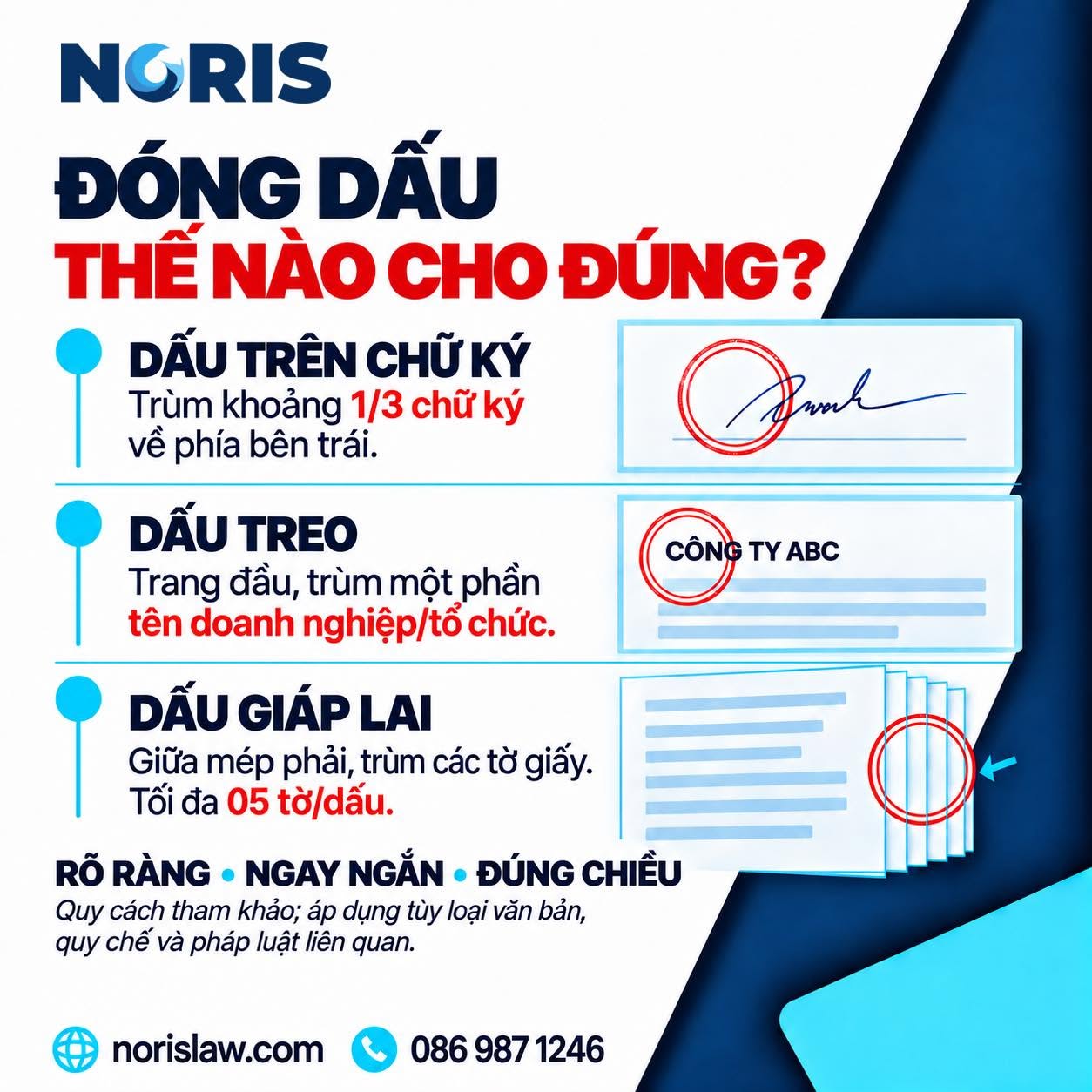
Three common methods are affixing a seal over a signature, using a header seal and applying a cross-page seal. Each serves a different purpose and should not be treated as automatically interchangeable.
Seals over signatures
A seal over a signature is usually placed so that it overlaps approximately one-third of the signature on the left. It should be straight, clear, correctly oriented and match the company's authorised seal design.
Before affixing the seal, check that the signatory has authority under the law, the charter, a delegation decision or a power of attorney. A seal does not validate the signature of a person who lacks authority.
Header seals
A header seal is usually affixed on the first page, partly overlapping the company's or organisation's name. In practice, it may identify documents issued by the company or authenticate appendices, quotations, notices and accompanying materials in certain circumstances.
However, a header seal does not automatically replace an authorised signature, nor is it mandatory for every document. The document's validity must still be considered alongside the signature, the agreed terms and the rules applicable to the transaction.
Cross-page seals
A cross-page seal is affixed around the middle of the right-hand edge so that its impression extends across the sheets. This helps show that the pages belong to the same document and reduces the risk of page substitution.
A commonly referenced standard is a maximum of five sheets per seal impression. Longer documents may be divided into groups of pages. For documents submitted as part of an administrative procedure, businesses should also check the receiving authority's requirements and any sector-specific rules.
Specific considerations for companies
Technical rules on sealing administrative documents primarily apply to bodies and organisations covered by the relevant records-management legislation. For companies, seal management and use also depend on the Law on Enterprises, the company charter, internal rules, agreements with counterparties and sector-specific regulations.
Businesses should therefore adopt rules specifying who holds the seal, who may request its use, which documents must be checked beforehand and how each use is recorded. A short, clear process helps prevent unauthorised use, sealing the wrong document or using the seal before supporting records are complete.
This article provides general information. For contracts and tendering, banking, tax, notarisation or sector-specific documents, businesses should check the requirements for each type of document before signing and sealing.